
In today’s digital world, almost every business needs an online presence. Whether it’s a small local business, a startup, or a large company, reaching customers online has become an important part of growing a business.
This is where a digital marketer comes in.
But what exactly does a digital marketer do?
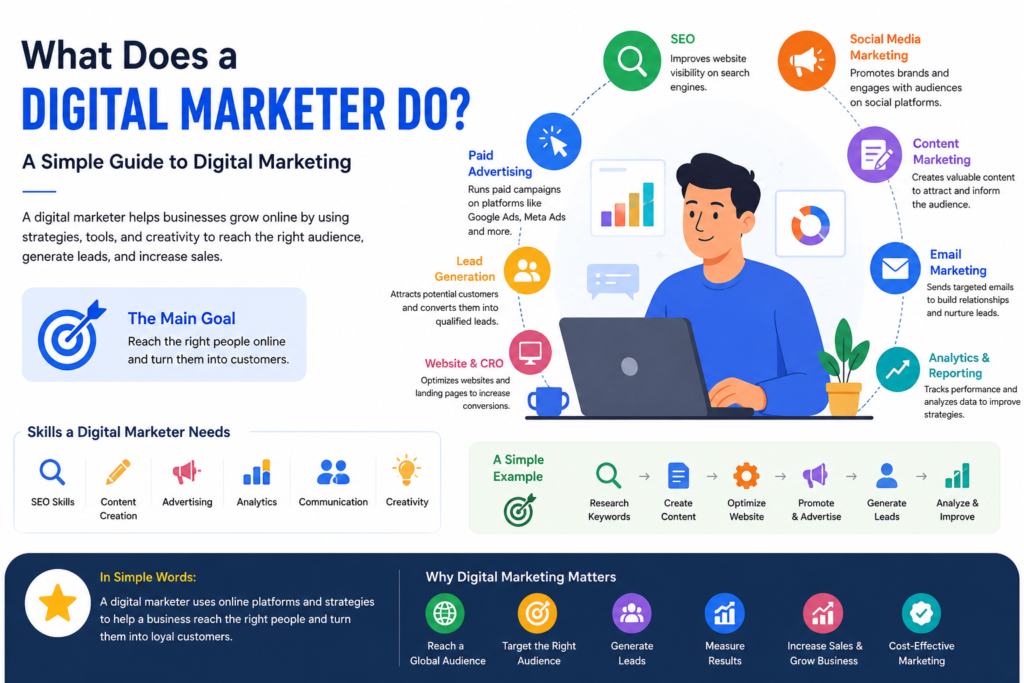
A digital marketer uses online platforms, marketing strategies, content, advertising, and data to help businesses reach the right audience, generate leads, increase website traffic, and grow sales.
In this blog, we’ll explain what a digital marketer does, the main areas of digital marketing, and why digital marketing is important for businesses.
What Is a Digital Marketer?
A digital marketer is a professional who promotes a business, product, or service through digital channels.
Instead of relying only on traditional marketing such as newspapers, television, or billboards, digital marketers use platforms such as:
- Websites
- YouTube
- Online advertising platforms
The main goal is simple:
Reach the right people online and turn them into customers.
A digital marketer may work on one specific area, such as SEO or social media, or manage several areas of digital marketing.
What Does a Digital Marketer Do?
A digital marketer can have many responsibilities depending on the business and marketing goals.
Here are some of the most common tasks.
1. Search Engine Optimization (SEO)
SEO is one of the most important parts of digital marketing.
The goal of SEO is to improve a website’s visibility in search engines such as Google.
For example, if someone searches for:
“Best web designer in Kerala”
a digital marketer may optimize a website to increase its chances of appearing in relevant search results.
An SEO-focused digital marketer may work on:
- Keyword research
- On-page SEO
- Technical SEO
- Content optimization
- Internal linking
- Website speed
- Local SEO
- Backlink building
- SEO performance tracking
The ultimate goal is to attract relevant organic traffic without paying for every visitor.
2. Social Media Marketing
People spend a significant amount of time on social media platforms, making social media an important marketing channel.
A digital marketer may manage platforms such as:
- YouTube
- X
Their responsibilities can include:
- Creating social media content
- Planning content calendars
- Writing captions
- Creating or coordinating graphics and videos
- Engaging with audiences
- Growing followers
- Running social media campaigns
- Analyzing performance
For example, a restaurant may use Instagram to showcase its food, attract local customers, and promote special offers.
3. Content Marketing
Content marketing focuses on creating useful and relevant content that attracts an audience.
A digital marketer may create or manage:
- Blog posts
- Articles
- Videos
- Infographics
- Social media posts
- Guides
- Case studies
- Website content
For example, a web development company could publish a blog titled:
“How to Choose the Right Website for Your Business.”
Someone searching for this information may discover the company’s website through Google and eventually become a potential customer.
Good content doesn’t just promote a business. It helps the audience solve a problem.
4. Paid Advertising
Digital marketers can also use paid advertising to reach potential customers quickly.
Common advertising platforms include:
- Google Ads
- Meta Ads
- LinkedIn Ads
- YouTube Ads
For example, a business selling digital marketing services could run a Google Ads campaign targeting people searching for “digital marketing agency near me.”
A digital marketer may be responsible for:
- Keyword research
- Audience targeting
- Ad copy
- Campaign setup
- Budget management
- Landing pages
- Conversion tracking
- Performance optimization
The goal is not simply to get clicks but to generate valuable leads or sales.
5. Lead Generation
Lead generation means finding people who may be interested in a business’s products or services.
A digital marketer can generate leads through:
- SEO
- Social media
- Google Ads
- Landing pages
- Email marketing
- Content marketing
- Lead forms
For example, a digital marketing agency could offer a free website audit.
A visitor enters their email address to receive the audit, becoming a potential lead for the agency.
6. Email Marketing
Email marketing allows businesses to communicate directly with customers and potential customers.
A digital marketer may create email campaigns for:
- Promotions
- Newsletters
- Product updates
- Special offers
- Educational content
- Follow-up campaigns
For example, an online store might send an email to previous customers about a new product or special discount.
Email marketing can help businesses build long-term relationships with their audience.
7. Website and Landing Page Optimization
A digital marketer also looks at how well a website converts visitors into customers.
Imagine that 1,000 people visit a website but only two people contact the business.
This could mean there is an opportunity to improve the website.
A digital marketer may analyze:
- Headlines
- Call-to-action buttons
- Landing page design
- Contact forms
- Page speed
- Website navigation
- Mobile experience
- Conversion rates
The goal is to make it easier for visitors to take the desired action.
That action could be:
Call → Contact → Sign Up → Buy → Book → Download
8. Analytics and Reporting
Digital marketing is not just about creating campaigns. A marketer also needs to understand the results.
Digital marketers use analytics to answer questions such as:
- How many people visited the website?
- Where did visitors come from?
- Which keywords generated traffic?
- Which social media posts performed best?
- How many leads were generated?
- How much did advertising cost?
- Which campaign generated the most sales?
Based on this data, marketers can improve their strategies.
Data helps digital marketers make better marketing decisions.
9. Local SEO
For businesses that serve customers in a specific location, local SEO is extremely important.
For example:
- Restaurants
- Salons
- Clinics
- Hotels
- Real estate businesses
- Local service providers
A digital marketer may optimize a business’s online presence so it can appear for searches such as:
“restaurant near me”
or
“web developer in Kozhikode.”
Local SEO can help businesses reach customers who are searching for their services in a specific area.
10. Building a Digital Marketing Strategy
One of the biggest responsibilities of a digital marketer is creating a marketing strategy.
A strategy usually starts with understanding:
Business → Audience → Goals → Platform → Content → Campaign → Measurement
For example, if a business wants more customers, a digital marketer might create a strategy like:
SEO + Google Ads + Social Media + Content Marketing + Landing Page Optimization
The exact strategy depends on the business, target audience, budget, and goals.
What Skills Does a Digital Marketer Need?
A successful digital marketer needs a combination of technical, creative, and analytical skills.
Important skills include:
SEO Skills
Understanding keywords, search intent, on-page SEO, technical SEO, and link building.
Content Skills
Being able to create useful and engaging content.
Social Media Skills
Understanding different social media platforms and how audiences behave on them.
Advertising Skills
Knowing how to create, manage, and optimize paid campaigns.
Analytics Skills
Understanding website traffic, conversions, campaign performance, and other marketing data.
Communication Skills
Being able to communicate ideas clearly with clients, customers, designers, developers, and other team members.
Creative Thinking
Finding new and interesting ways to attract and engage an audience.
Digital Marketer vs SEO Specialist
These two roles are related but not exactly the same.
An SEO specialist primarily focuses on improving a website’s visibility in search engines.
A digital marketer may work across several channels, including:
SEO + Social Media + Paid Ads + Content + Email + Analytics
So, SEO can be considered one important part of digital marketing.
Why Is Digital Marketing Important?
Traditional marketing can be expensive and difficult to measure.
Digital marketing gives businesses more opportunities to reach specific audiences and measure results.
Some major benefits include:
- Reach customers globally
- Target specific audiences
- Generate leads
- Increase website traffic
- Build brand awareness
- Measure campaign performance
- Improve customer engagement
- Increase online sales
For small businesses especially, a well-planned digital marketing strategy can help them compete with larger businesses online.
A Simple Example of Digital Marketing
Let’s say you own a small web development company.
A digital marketer could create a strategy like this:
Step 1: Research keywords related to web development.
Step 2: Create useful SEO blogs targeting those keywords.
Step 3: Optimize the company’s website.
Step 4: Share the content on social media.
Step 5: Run Google Ads for high-intent searches.
Step 6: Send visitors to a professional landing page.
Step 7: Track leads and conversions.
Step 8: Analyze the results and improve the campaigns.
This is how different areas of digital marketing can work together to generate business.
Final Thoughts
So, what does a digital marketer do?
A digital marketer helps businesses grow online by using strategies such as SEO, social media marketing, content marketing, paid advertising, email marketing, lead generation, website optimization, and analytics.
The job is not simply about posting on social media or running advertisements.
A good digital marketer understands the audience, business goals, marketing channels, and data and uses them together to create an effective strategy.
In simple words:
A digital marketer helps the right business reach the right people at the right time through the right digital channel.
As more businesses move online, digital marketing continues to be an important skill for companies that want to build their brand, attract customers, and grow.